16 chapters
How I got into coffee
I drank instant coffee for most of my life and thought nothing of it. Café coffee always tasted different to mine, and I could never work out why. This is what happened when I went looking, and the handful of things I wish someone had explained to me at the start.
Part one
How I got here
Where I actually started
There is a jar of Nescafé Dark Roast in my cupboard, and it is going at the top of this page rather than hidden at the bottom, because let us be honest, this is where all of us started.
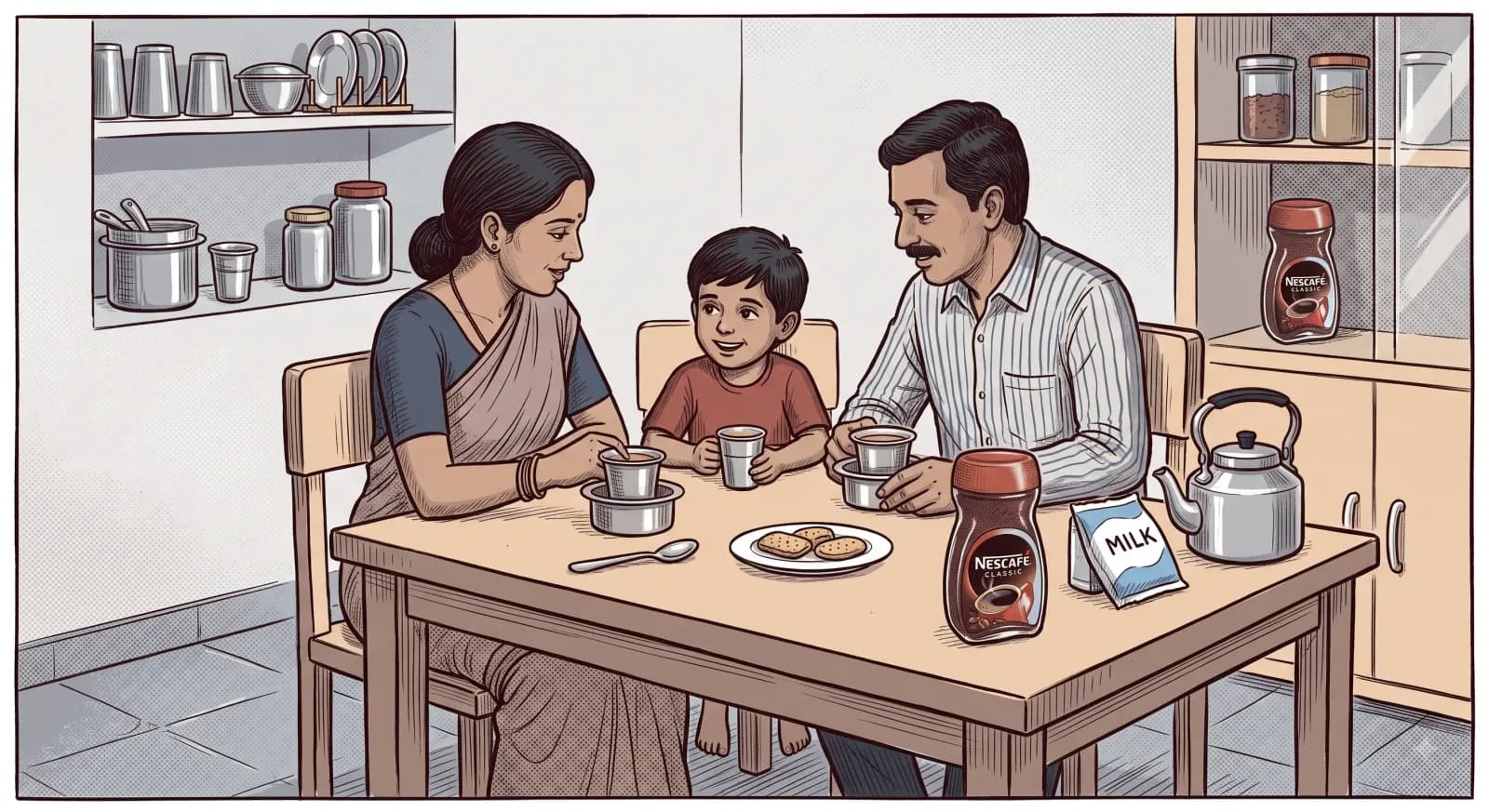
Instant is how almost every Indian meets coffee. It is in the house before you have heard the word specialty, before you know what a roast level is, before you have any idea that beans have origins. A spoon, hot water, milk, sugar if you take it. That was coffee in my home growing up, and it stayed my coffee right up until a few years ago. If you are reading this with a mug of it going cold beside you, no need to be shy. Same, most weeks.
So when I read people online talking about instant as though it were a failure of character, I find it hard to take seriously. They are describing my childhood, and the daily cup of most people I know, and honestly a fair chunk of my own adult life. I am not going to stand on the other side of a door I walked through myself and pull a face at it.
It also helps to know what instant actually is. It is brewed coffee that has been dried into granules so you can bring it back later with hot water. A different product with a different job, and the job is real: some mornings I have eleven minutes before a call, and the choice is between instant and nothing.
What sent me looking was cafés. Coffee from a café always tasted different to what I made at home. Not better exactly, just different, and it was a difference I could not get anywhere near on my own. I wanted to know how they were doing it, and that question turned out to have a whole world behind it.
None of what follows is me growing out of instant. The jar has not moved. It is just what happened after I got curious.
It started with a YouTube video
For years coffee was just the thing that happened before work. Then I came across James Hoffmann, and it turned out there was a whole craft sitting underneath something I did every morning without thinking. If you only take one thing from this page, take his channel.
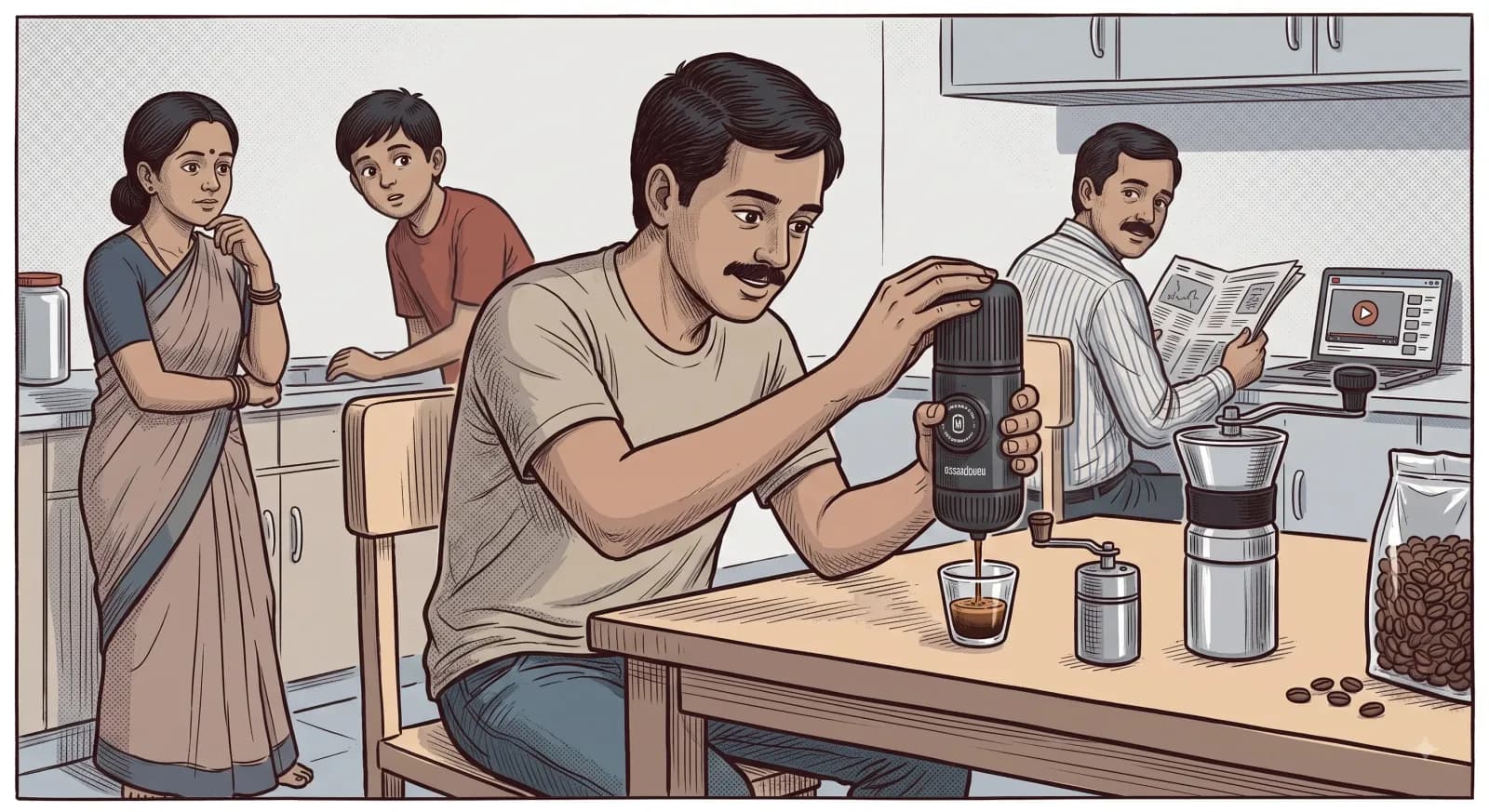
My first piece of gear was a Wacaco Nanopresso and a very basic grinder. The Nanopresso is a hand pump. You put in the grounds, add hot water, and pump until espresso comes out. It costs very little and it makes a genuinely good shot, which is exactly the problem, because it makes you wonder how much further this goes.
Why a lever press, of all things
The next thing I bought was a Flair Pro 2, and it is worth explaining what that actually is, because a lever press looks strange if you have only seen café machines.
Espresso is hot water pushed through finely ground coffee under pressure. Pressure is measured in bars, where one bar is roughly the air pressure you are standing in right now.
Nine bars is the number everyone quotes, and nearly every machine ever built is designed around it. It is worth knowing that it is a convention rather than a law of physics. In practice anywhere from six to nine bars makes good espresso, and plenty of people who have thought about it harder than me prefer the lower end, on the grounds that gentler pressure is less likely to punch a channel straight through the coffee. Nine is the default, not the target.
A pump machine settles that question for you. It pushes at whatever pressure it was built to push at, and you do not get a vote. A lever press hands the job to your arm. You load the basket, pour in hot water, and pull the arm down. Your own weight is the pressure, and because the arm is long you can feel exactly what is happening: where the resistance builds, where it eases as the coffee gives way.
That sounds like a downgrade until you notice what it buys you. You are not just supplying the pressure, you are shaping it over the course of the shot. On most machines that is fixed in the factory. Better ones give you control of temperature and timing, and the genuinely expensive ones let you vary pressure as the shot runs. On a lever, that last one is just how it works.
Pre-infusion, the bit worth learning
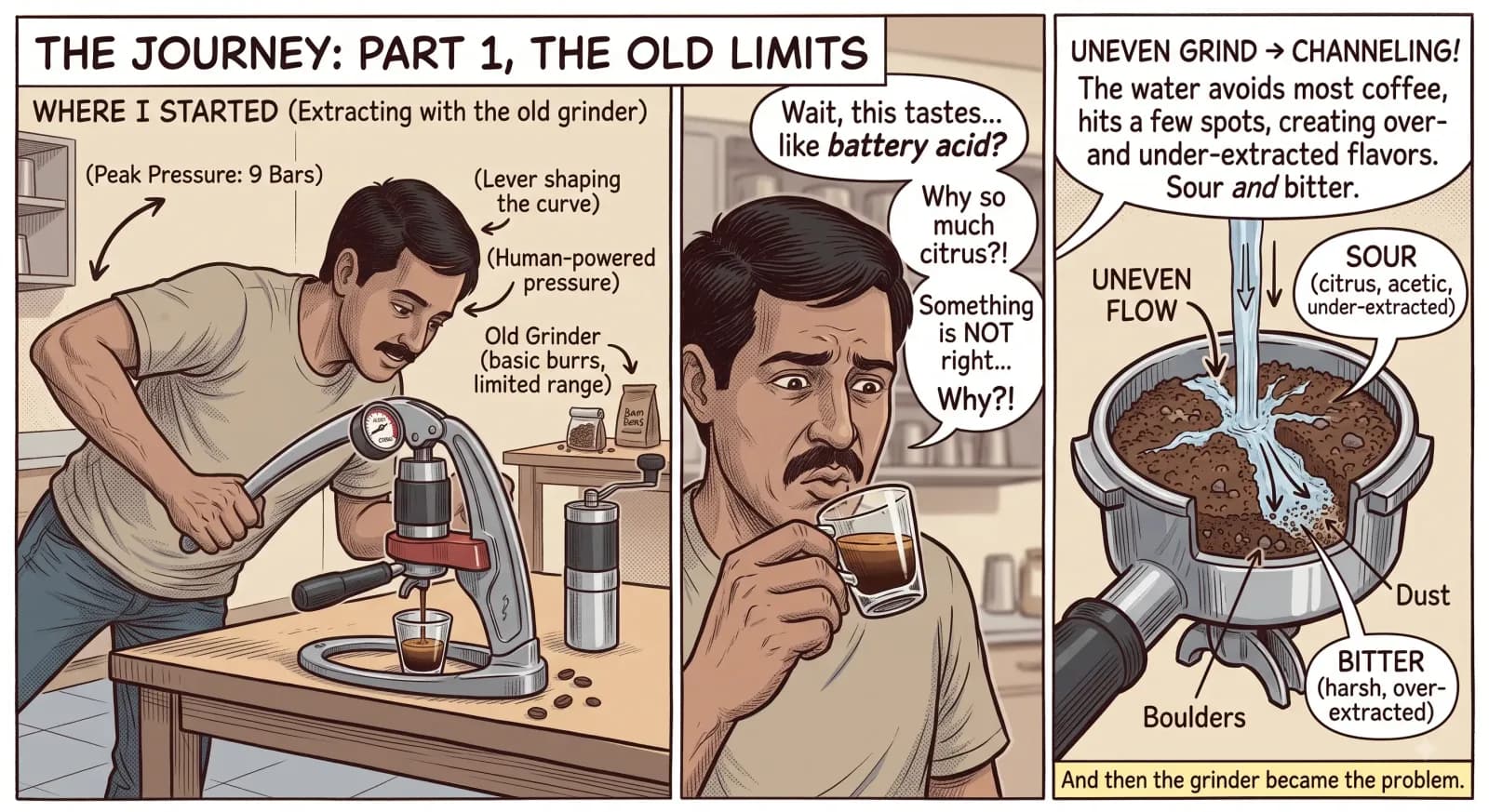
Dry coffee does not absorb water evenly. Hit a dry puck with full pressure and the water finds the path of least resistance, carves a channel, and rushes through it while the rest of the coffee sits there barely touched. That is the sour and bitter cup at the same time.
The fix is to wet it gently first. Ease in at around three or four bars, hold there for a few seconds while the coffee soaks and swells shut, and only then push on to six, seven, eight, nine. The trade is a few seconds against a much more even extraction.
The word for this is pre-infusion. On espresso machines it is a feature, sometimes a costly one. On a lever you simply do it with your hand, and after a while you stop counting seconds and start going by feel.
Hoffmann's argument was that a good lever gets you espresso genuinely close to machines costing many times more, because the expensive parts of a machine are the ones holding temperature and pressure steady, and a lever hands both of those jobs to you. Having used one for a while, I think that is right. You are the pump, and the pump is the part you were going to pay for.
There is no motor and nothing to break, and it taught me more about extraction in a month than reading would have in a year. When a shot ran fast and tasted thin, I could feel that it had run fast.
The foam on top
The tan layer on an espresso is called crema, and it is worth a minute, because most people read it as a scorecard and it is not one.
Roasting leaves a bean full of carbon dioxide. Under pressure that gas goes into the liquid, and the moment the shot leaves the machine and meets ordinary air it comes back out as thousands of small bubbles, held together by the coffee's own oils. That is crema, and it is why filter coffee has none: nothing ever pressurised it. The bloom you see when you pour water on fresh grounds is the same gas leaving, just with nowhere to be trapped.
Which means crema mostly tells you about freshness, not quality. The clearest evidence is robusta: it reliably produces more crema than arabica, whatever the coffee tastes like. A very fresh bag gives a thick head, an old one barely any, and a beautifully crowned shot can still taste like nothing. Judge the drink.
Two things worth knowing. A great deal of crema is a hint that the beans have not rested long enough, though only a hint, because species and roast move it too. And on its own crema tends to taste bitter and intense, which is why plenty of experienced people stir it in rather than protect it. World Barista Championship judges are told to stir the shot before tasting. You are allowed to.
Then the grinder became the problem
So I had a press that let me set the pressure exactly, and my coffee did not improve. The shots gushed out in about ten seconds and tasted like brown water, and leaning harder on the arm changed nothing.
It took me a while to work out why pushing harder did nothing. The pressure does not really come from the lever. It comes from the coffee getting in the way. Grind too coarse and there is nothing in the way: the water finds a clear path straight through and is gone before it has picked up much flavour, however slowly and however carefully I pulled the arm. A fast, thin shot is almost never fixed at the lever. It is fixed at the grinder.
Except I could not fix it. My old grinder was already on its finest setting, and there was simply no more dial to turn. That is the quiet limit of a cheap grinder: not that it grinds badly, but that it runs out of road right where espresso starts.
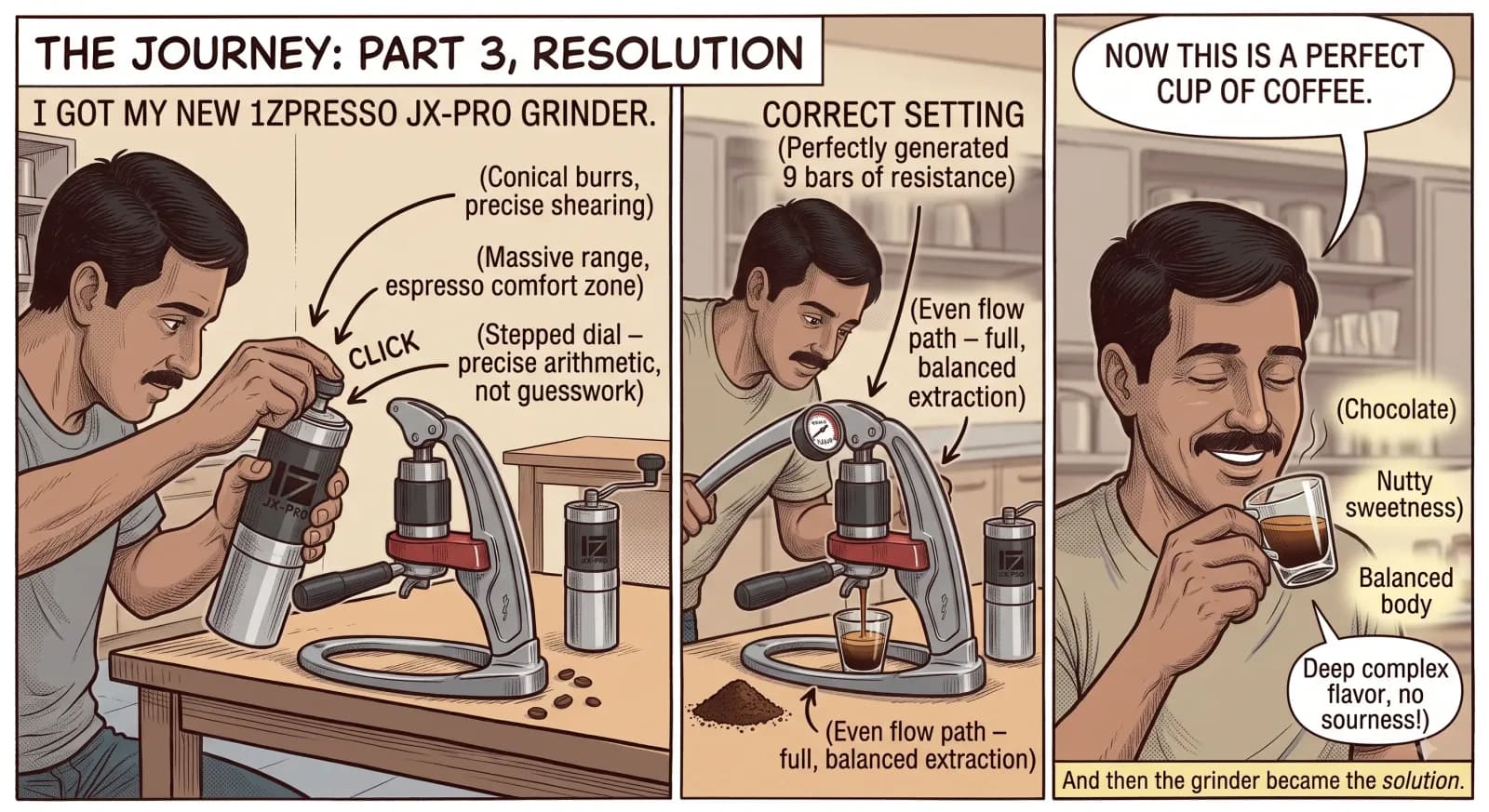
I went for a 1Zpresso JX-Pro. It is a hand grinder with conical burrs, which means two cone-shaped cutters shear the beans into pieces of a similar size rather than smashing them. Even grounds matter because water flows through them evenly, so you get one extraction rather than some of it over-extracted and some of it under.
It also has range to spare. Espresso sits comfortably inside its dial rather than at the very end of it, and if you keep turning you go past espresso, past flour, and somewhere into splitting the atom. I will never use that end. Knowing it is there is the point.
The part I did not expect to care about is the stepped dial. Every click is a known amount coarser or finer, so espresso and pour over sit a fixed number of clicks apart. Dialling in stops being guesswork and becomes arithmetic.
If you remember one thing from this page
Your grinder matters more than your machine. A modest brewer and a good grinder will beat an expensive machine and a bad one, every time, and it is not close.
The reason is simple once you see it. Water takes the path of least resistance. If your grounds are a mix of boulders and dust, water rushes past the big pieces and floods the small ones, so the same shot is under-extracted and over-extracted at once. You taste that as sour and bitter together, and no amount of machine will fix it, because the machine is not the thing making the mess.
A good grinder produces particles of a similar size. Water moves through them evenly, everything extracts at about the same rate, and the cup tastes like one thing instead of three. That is the whole mechanism.
So if you are choosing where the money goes, put it in the grinder first. You can pull genuinely excellent coffee out of very ordinary equipment once the grind is right.
And then time became the problem
The manual workflow is lovely, and it is also about fifteen minutes I do not have on a Tuesday morning. So I bought a Budan, a semi-automatic machine made here in India. It heats itself while I do something else, and a weekday coffee stops being a project.
The part that sold me was what is underneath it. The Budan is built on the CRM3605, a chassis made by Gemilai and sold all over the world rebadged under a dozen different names. That sounds like a knock and it is the opposite of one.
A platform that many brands share is a platform that many people own, which means it has been taken apart, photographed, argued about on forums and fixed in kitchens for years. Gaskets, shower screens, solenoids and pumps are commodity parts you can order without hunting. It carries a 58mm group, so every tamper, distributor and basket made for café machines fits it. When something eventually goes, I can open it rather than post it somewhere.
I did not stop doing it by hand. Weekends I still go the long way round, heating the apparatus, weighing everything, pulling the lever. The slow version is the part I actually enjoy. The machine is for the mornings when enjoying it is not the point.
Everything on my shelf, in order
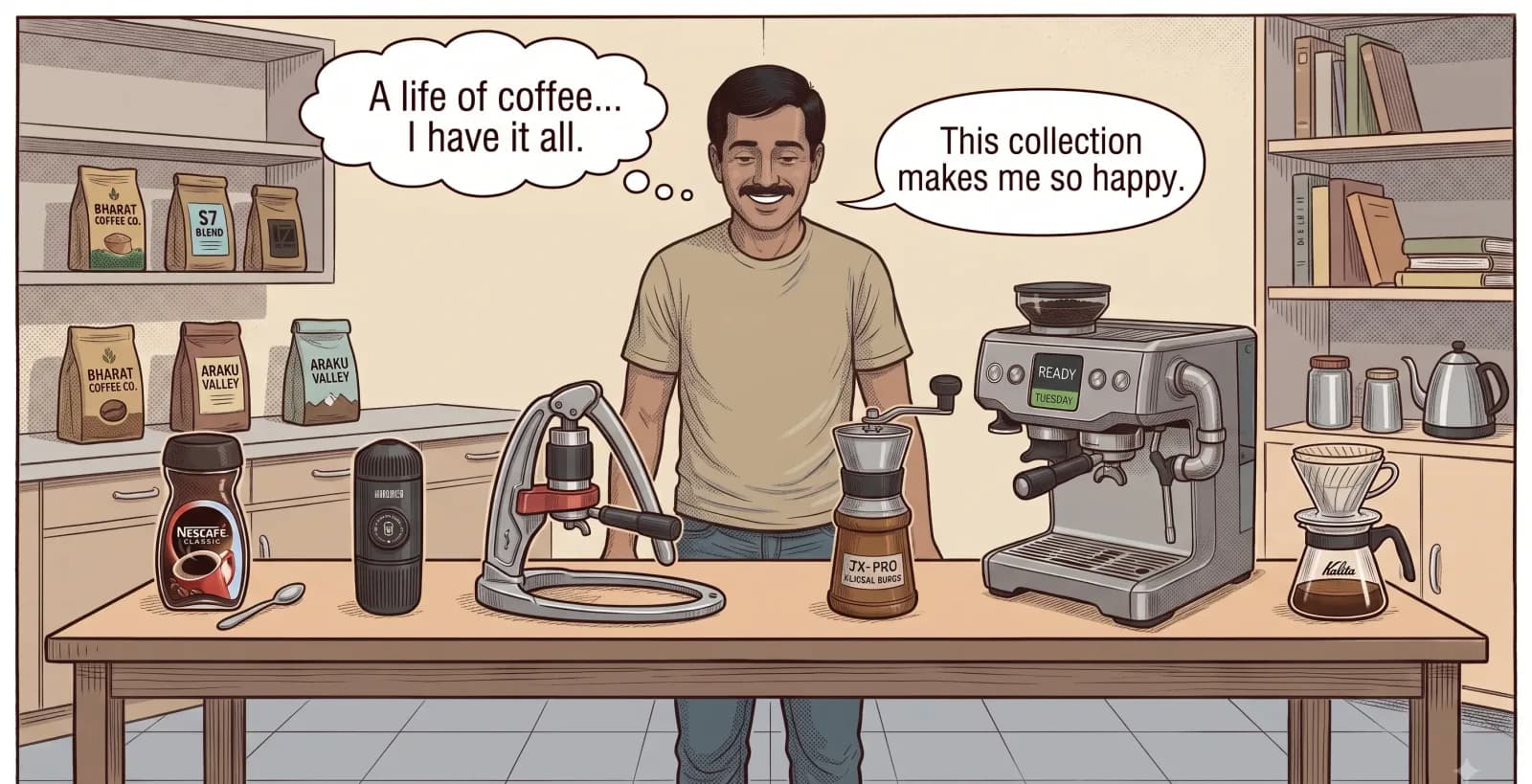
The whole list in one place, since it is scattered through the story above. Each one links to where I bought it.
- Started hereWacaco NanopressoHand pump
- The upgradeFlair Pro 2Lever press
- The real bottleneck1Zpresso JX-ProHand grinder
- Weekdays nowBudanSemi-automatic
- WeekendsKalita Wave 185Pour over
I still drink both
I pick by mood and by clock as much as by taste. Weekend, unhurried, happy to fuss: the lever and the Kalita. Weekday, thinking about something else: the Budan. Running for the door: the jar. All three are me, and the jar has been me for the longest.
If you drink instant and you are happy, you are done. Nothing on this page is asking you to change.

Part two
What I learnt along the way
Roast levels, from the beginning
Start here, because this is the word on the front of every bag and it decides more about how your coffee tastes than almost anything else you can buy.
What a roaster is actually doing
A coffee bean is a seed. It grows inside a small red fruit, and before anyone roasts it, it is green, it smells faintly of hay, and it tastes of nothing you would want. Roasting is cooking it. That is the entire craft: applying heat to a seed until it becomes something worth drinking.
Heat does two useful things. It drives the water out, and it browns the sugars inside the bean, which is the same reaction that makes bread crust taste different from bread dough.
While that happens, the roaster is listening. Beans make two distinct sounds as they cook, and those two sounds are the landmarks the whole craft is built around.
- First crack
- Steam builds up until it bursts the bean open, with a loud pop that sounds like popcorn. The bean is now drinkable. Stop here or just after, and you have a light roast.
- Second crack
- Keep going and there is a second, quieter, cracklier round of popping as the structure gives way further and oil is pushed out to the surface. Around here you are at medium-dark. Go through it and you are at dark.
That is all a roast level is: how long the roaster waited, measured against those two sounds. Light, medium, medium-dark and dark are four names for four places to stop.
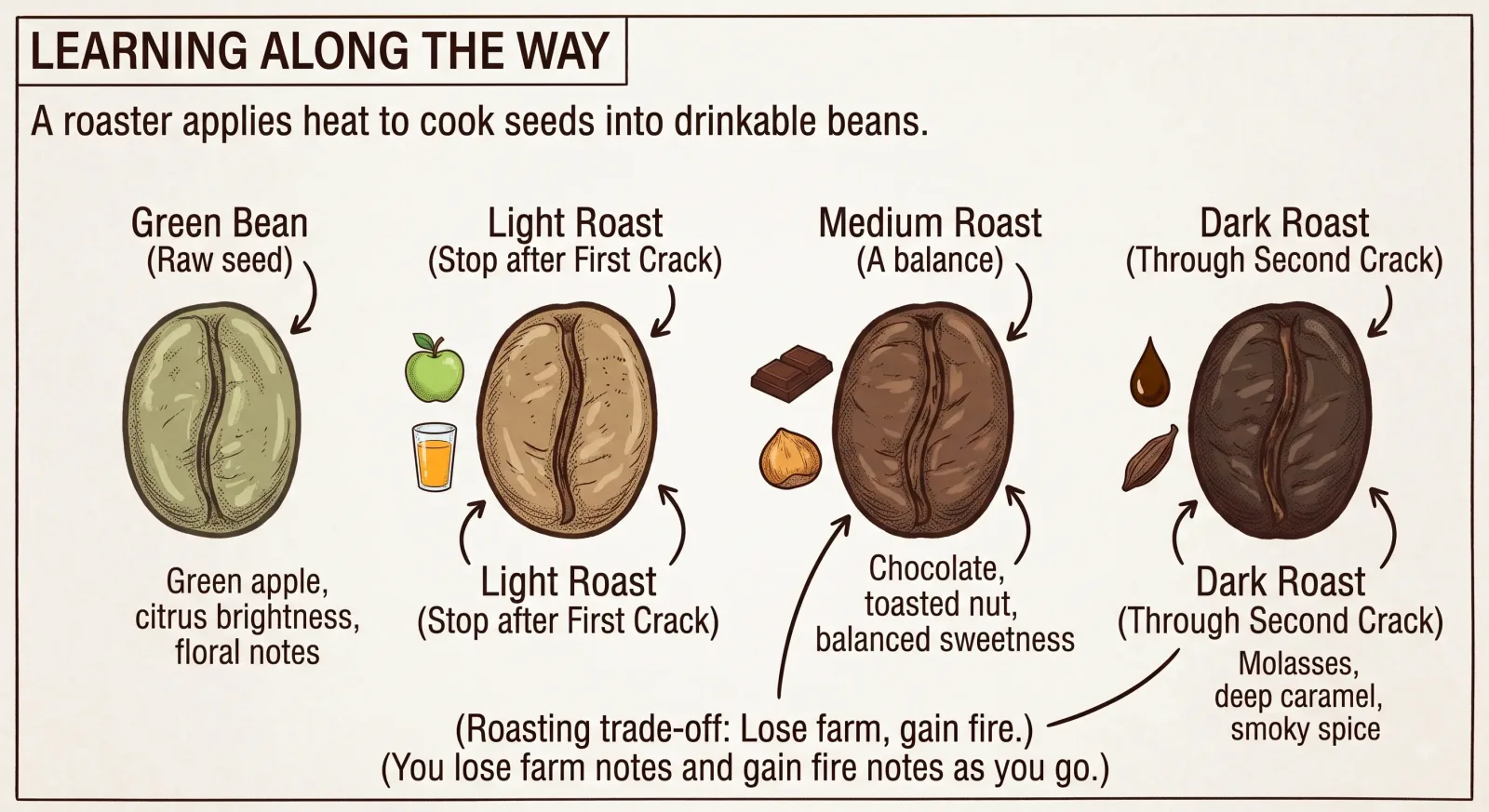
A useful shorthand for the whole picture above: you lose farm and you gain fire.
You will see roast temperatures quoted, usually around 200°C for first crack. Treat them loosely. That number is a probe reading, and because every machine puts its probe in a slightly different place, first crack is reported anywhere from 170°C to 207°C by people who all know exactly what they are doing. The sounds are the same on every machine. The numbers are not.
And there is a trade running underneath all of it. The longer a bean roasts, the more of the farm you lose and the more of the fire you gain. Acidity falls, body rises, and the flavours that came from the soil and the altitude give way to flavours that came from the roaster. Neither end is better. Anyone telling you light roast is objectively superior is describing their own preference. Mine sits firmly at the dark end.
Acidity is not sourness
This one word confuses more beginners than anything else on this page, so it is worth thirty seconds.
When coffee people say acidity, they mean brightness. The snap of a green apple, the lift of orange juice. It is a compliment. It is a thing people pay more for.
Sourness is a different thing and it is a mistake. It is what you get when water has not pulled enough out of the coffee, which is nearly always a grind problem rather than a bean problem. If a light roast tastes sharp and unpleasant and thin, the honest first assumption is not that you dislike light roast. It is that you under-extracted it. Grind finer and try again before you blame the bag.
Pick a roast and see what to do with it
Drag the slider. This is the part that took me the longest to work out by trial and error, and it fits on one screen.
Drag to change the roast
Medium-dark roast
Medium-dark
Taken right up to the second round of popping. Oil starts appearing on the surface of the beans.
Mostly gone. The brightness has turned into sweetness.
Full and slightly syrupy. It coats your mouth.
Tastes like
Dark chocolate, molasses, a bit of baking spice. The fruit has turned into something rounder and heavier, and the roast is starting to speak louder than the farm.
Make it as
- Pour overFine, but you are spending clarity on a coffee with less to reveal.Works
- French pressBody on body. This is a comfortable pairing.Great
- EspressoThe classic sweet spot, and the easiest place to learn to dial in.Great
- Latte, cappuccinoBest in class. Chocolate and nut survive a jug of milk. Lemon and jasmine do not.Great
- Cold brewSmooth and chocolatey, and very good over ice.Great
- Moka potRich and forgiving.Great
Remember this: This is the milk drink roast. If you mostly make lattes at home, start here and stop reading the light roast reviews.
One warning about the labels
Nobody agrees on what these words mean. There is no standards body checking that your medium is the same as my medium, so every roaster calibrates their own scale, and some of them calibrate it hot.
Starbucks are the famous example. Buy their medium and you will get something sitting roughly where most roasters would print dark on the bag. Buy their dark and you are in a different conversation entirely, one where the beans have clearly had a long and difficult afternoon.
I am not saying this to be rude about them. I keep buying it. Just shift your expectation one notch darker than the label promises, and if you already know you dislike smoky, heavy coffee, their medium is where you should start rather than where you should stop.
The wider lesson is more useful than the joke. Treat roast labels as one roaster talking about their own range, never as a measurement you can carry between brands. The only reliable calibration is a bag you have already drunk.
This is not me being cynical, incidentally. There is a lab measurement for roast colour, and when people run it, Starbucks Pike Place, sold as a medium, and Peet's Major Dickason, sold as a dark, land in the same very dark band. Two different words on two bags for effectively the same roast.
While we are killing myths: caffeine
You will hear that dark roast has more caffeine because it is stronger, and you will hear the opposite from the other half of the internet. Here is the boring truth.
Caffeine barely cares about roasting. It survives the temperatures involved almost untouched, so if you weigh your coffee on a scale, roast level makes almost no difference. One study that brewed five roast levels carefully found the peak in the cup was somewhere around medium, and concluded that how you brew matters more than how it was roasted.
The popular claim is only true if you measure by the scoop. Light roast beans spend less time expanding, so they stay denser, and a scoop of them weighs more than a scoop of dark. More bean, more caffeine. Weigh instead and the whole argument disappears.
Reading the rest of the bag
Roast level is the word you notice first. The rest of a specialty bag reads like a form somebody forgot to explain, so here is a short decoder. You do not need all of it to buy good coffee. You need enough that the bag stops being intimidating.
Single origin, or a blend
Single origin means the coffee came from one place. The catch is that nobody has agreed how big “one place” is, and there is no official definition. It can mean one country, one region, one co-operative, one farm, or one specific plot on one farm. “Single origin, Brazil” tells you almost nothing, because Brazil grows about a third of the world's coffee. A named estate tells you a great deal.
A blend is coffee from more than one place, mixed on purpose. Anything that is not single origin is a blend. There is no such thing as a “double origin”, and no triple either. Two origins in a bag is simply a blend of two.
Blends have a reputation for being the cheap option, and that reputation is out of date. Roasters blend for real reasons: coffee is a crop, so a single farm's lot runs out and tastes different next harvest, while a blend can be adjusted to taste the same all year. Blends are also built deliberately to have enough body to cut through milk. If you want proof this is not a compromise, the coffee that won the World Barista Championship in 2023 was a blend.
Which should you buy first? If you mostly make lattes, buy a roaster's house espresso blend, because it was designed for exactly that job. If you brew filter and want to learn what origins actually taste like, buy two contrasting single origins at once, say an Ethiopian and a Colombian, and drink them the same week. The difference is the lesson.
Arabica and robusta
These are two species of coffee plant. Arabica is the one specialty coffee is mostly built on: sweeter, more acidic, more aromatic, fussier to grow, more expensive. Robusta has roughly twice the caffeine, more bitterness, less sugar, grows lower and hotter, and resists disease far better.
Robusta's bad reputation is real but is also partly a story about money rather than the plant. For decades nobody paid for good robusta, so nobody grew good robusta. There is now a defined fine robusta grade with its own graders and standards, and it matters here more than most places: roughly 70% of the coffee India grows is robusta, and Indian roasters sell single-origin robusta that is genuinely good, which is still unusual worldwide.
Which brings up the label you have definitely seen. “100% arabica” is not a quality claim. It is a statement about species and nothing else, and there is an enormous amount of mediocre arabica in the world. It meant something when the alternative was cheap robusta padding out a supermarket tin. Notice that the bags you most want to buy usually do not bother saying it.
How the fruit was removed
Every coffee bean starts inside a fruit, and somebody has to get it out. How they did it changes the taste as much as the roast does, which is why it is printed on the bag.
- Washed
- The fruit is stripped off before drying. You taste the seed and the place it grew, with nothing in the way. Cleaner and brighter, and the usual choice when a roaster wants chocolate and caramel to lead.
- Natural
- The whole fruit is dried with the seed still inside, so the sugars soak in. Much fruitier, heavier, sometimes almost like wine or berry jam. Harder to do well, because fruit left on a drying bed can go wrong.
- Honey, or pulped natural
- The middle path. The skin comes off but the sticky layer underneath stays on to dry. Sweet, between the other two. There is no honey involved. That sticky layer just looks and behaves like honey, and the name stuck.
For a beginner's palate, this is often a louder difference than the country on the bag. A washed Ethiopian and a natural Ethiopian can taste less alike than two washed coffees from opposite sides of the world.
The date that matters
Look for a roast date, not a best before date.
Coffee does not spoil the way milk does. It is shelf stable, so a best before date twelve months out is a legal formality that tells you nothing about flavour. What coffee does is go flat, and it starts the day it is roasted.
Fresher is not automatically better either, which surprises people. Fresh coffee is full of carbon dioxide, and that gas pushes water away from the grounds and gives you a sour, uneven cup. So a bag wants a few days between the roaster and you. Rest it before you judge it.
How long depends on two things at once, which is why nobody agrees on a number. Roast level sets the direction. Darker roasting leaves the bean more porous, so it sheds its gas faster and is ready sooner. A light roast holds on to it and takes longer. Brew method shifts the window. Espresso is fussier, because gas escaping inside a pressurised puck fights the water going through it, where a filter brew just lets it bubble off.
| Roast | Filter | Espresso |
|---|---|---|
| Dark | 2 to 5 days | 3 to 7 days |
| Medium | 3 to 7 days | 5 to 10 days |
| Light | 5 to 14 days | 7 to 21 days, sometimes more |
Those are starting points and not expiry dates. I have deliberately not given you one tidy rule, because the people who actually measure this do not agree on one. Square Mile say five to fourteen days for filter and seven to fourteen for espresso whatever the roast. Scott Rao rests a dark oily roast for a day or two and a very light one for up to four weeks. Both are right about their own coffee.
If you want a single habit rather than a table: open the bag around day five, and if it tastes thin and sharp, wait and try again in three days. Judge it by the cup rather than by the calendar.
And do not sit on it forever
There are two clocks running. The first is the gas leaving, which is the one you wait out. The second is staling: aroma escaping and the oils slowly oxidising, and that one never stops.
Coffee does not fall off a cliff on a particular day. It fades. The Specialty Coffee Association puts whole beans at roughly three weeks of being properly fresh, and that is a fair target to drink within rather than a deadline. What you lose past it is aroma and sweetness, slowly, until one day the cup tastes flat and you cannot say when that happened.
The single biggest freshness fact, and the reason a grinder is worth more than a machine: whole beans stay good for around three weeks. Ground coffee stays good for about an hour. Grinding multiplies the surface exposed to air enormously, and most of the trapped gas is gone within minutes.
Keep the bag closed, cool and out of the light, and buy in amounts you will actually drink. The fridge is the one place not to put it, because it is damp and coffee takes on moisture and smells.
The freezer, though, genuinely works, which surprises people who were told otherwise years ago. Frozen properly, coffee ages dramatically more slowly. The condition is moisture: freeze it in small sealed portions, and let a portion come back to room temperature before you open it, or water condenses straight onto cold beans.
What you can safely ignore for now
Altitude. “1600 MASL” means metres above sea level. Higher usually means colder, which means the fruit ripens more slowly and develops more flavour, so it is weak evidence that the roaster buys carefully. It is not comparable between countries, because 1,600 metres near the equator and 1,600 metres far from it are completely different climates.
Cupping scores. A number like “86 points” comes from a tasting protocol where 80 and above counts as specialty. On a retail bag it is usually self-assigned by the roaster or their importer, and one point is inside the margin of error for most professional tasters. It carries real weight when it comes from a competition or a public auction, and very little otherwise.
Variety names. Bourbon, Typica, SL28, Gesha and the rest are to coffee what Granny Smith is to apples. Worth knowing later. Worth ignoring while you are still working out whether you like fruit or chocolate.
Portafilters, and why 58mm keeps coming up
The portafilter is the handle you lock into an espresso machine. It holds a metal basket, the basket holds the coffee, and the whole thing seals against the machine so pressurised water has nowhere to go except through the puck.
The number is the diameter of that basket in millimetres, and it matters more than it sounds like it should.
58mm
The commercial standard. Nearly every café machine uses it, so tampers, distributors and baskets are easy to find and cheap.
54mm
Common on home machines from Breville and others. Good gear exists, but you have fewer options.
51mm and under
Entry-level and portable brewers. Smaller dose, and accessories get genuinely hard to find.
A wider basket spreads the same dose into a shallower bed, so water travels through less coffee and does it more evenly. That is the real reason 58mm became the standard rather than tradition. If you are buying a machine, check the size before you check anything else, because it decides what accessories you can ever buy for it.
Ways to make it
Three families, and they want different grinds.
- Espresso based
- Hot water forced through a compacted puck at pressure, in about thirty seconds. Fine grind. This is the base for a cortado, a latte, a flat white. Everything on a café menu is espresso plus milk in some ratio.
- Pour over and filter
- Water poured over a bed of coffee and allowed to drain through, over two to four minutes. Coarser grind, no pressure, lighter body. A Kalita Wave and a V60 both sit here. Cleaner in the cup, and far more forgiving of a small mistake.
- Immersion
- Coffee sits in water for a set time, then gets separated. A French press is the obvious one. Coarsest grind, heaviest body, and the hardest one to get badly wrong.
None of these is the correct way. They pull different things out of the same beans, and the one you like is the right one.
Grind size, and the one rule behind it
Espresso wants a fine grind. Pour over wants a coarser one. Almost everyone learns those two facts as things to memorise, which is a shame, because they both fall out of a single idea.
Grind size is set by how long the water and the coffee spend together.
Break a bean into smaller pieces and you create far more surface for water to work on, so it gives up its flavour faster. Leave the pieces large and there is less surface, so extraction is slower. That is the whole lever you are pulling.
Put an espresso grind in a French press for four minutes and you extract everything, including all the bitter compounds you were hoping to leave behind. Put a French press grind in an espresso basket and the water runs straight through in eight seconds and tastes of almost nothing.
When to move it
Taste first, then adjust one thing.
- Sour, thin, and it ran fast
- Under-extracted. You did not get enough out. Grind finer. That slows the water down and gives it more surface to work on.
- Bitter, harsh, drying, and it ran slow
- Over-extracted. You pulled out too much. Grind coarser. Water moves through faster and takes less with it.
- Both at once
- Usually not a grind size problem. That is the channeling in the picture further up, so look at your distribution and your tamp before you touch the dial.
A stepped grinder makes this much easier to live with. On my JX-Pro, espresso and pour over sit a fixed number of clicks apart, so moving between them is a count rather than a memory, and a change I liked is a change I can find again.
Ratios, so you have somewhere to start
A brew ratio is coffee in against liquid out, both by weight. Weighing is the single change that makes your coffee repeatable, because volume lies and a scale does not.
Espresso
The Specialty Coffee Association puts the sweet spot at 1:2 to 1:2.5, and that is where I live. Start at 18g in and 36g out in about 30 seconds. If it tastes sour, grind finer. If it tastes harsh and bitter, grind coarser. Change one thing at a time.
Pour over and filter
Much more water, much longer contact, so the numbers look completely different. 1:16 to 1:17 is the reliable starting point: 20g of coffee to 320g of water.
The SCA Golden Cup standard is 55g of coffee per litre with a 10% tolerance either way, which works out at roughly 1:17 to 1:20. Most people I know brew stronger than the middle of that. The useful thing about a ratio is not that it is correct, it is that it is repeatable, so when a cup is good you can make it again.
Where I buy
Coffee gear is a category with a lot of noise in it, and buying badly is expensive. Nearly everything on my shelf came from one of two places, and I would send a friend to either. The grinder is the exception: that one came direct from 1Zpresso.
- Something's Brewing
- Where the Budan and the Nanopresso came from. Broad range across machines, grinders and brewers, and they carry the Indian brands as well as the imports. Good first stop if you are not yet sure what you want.
- Benki Brewing Tools
- Where the Flair and the Kalita came from. More focused, more of a specialist selection, and the sort of place that stocks the specific thing rather than twelve near-misses.
Neither of them pays me anything and these are not affiliate links. They are simply where my money went.
Where people actually talk about this
Most of what I know past the basics came from reading other people argue about it. These are the corners of Reddit I follow, and they are a genuinely warm bunch. If you want to go further than this page does, your time is better spent there than on more of me.
- r/IndiaCoffee
Indian roasters, Indian prices, and people solving the same shipping and humidity problems you are. The most useful of the four if you are here.
- r/espresso
Dial-in help, machine repairs, and a steady stream of people posting a shot and asking what went wrong. Read the answers even when the question is not yours.
- r/JamesHoffmann
Discussion around the videos, plus the follow-up questions the videos leave open.
- r/latteart
Pure practice and encouragement. Worth it for how patient people are with beginners posting their first blob.
Worth saying plainly: nobody there is precious about it. Turn up with a bad shot and a question and you will get five careful answers.
The words, in one place
Everything above, without the article around it. Worth a look before you buy a bag, or after one of these turns up on a menu.
| Term | What it means |
|---|---|
| Arabica | The species most specialty coffee is made from. Sweeter and more aromatic than robusta, and fussier to grow. |
| Robusta | The other species. Roughly twice the caffeine, more bitter, hardier. About 70% of what India grows. |
| Single origin | Coffee from one place. Nobody has agreed how big a place, so it can mean one country or one plot on one farm. |
| Blend | Coffee from more than one place, mixed deliberately. There is no such thing as a double origin. |
| First crack | The popping sound as steam bursts the beans open in the roaster. Stop here or just after and you have a light roast. |
| Second crack | A quieter, cracklier round of popping later on, as oil is pushed to the surface. Through it and you are at dark. |
| Washed | The fruit is stripped off before drying. Cleaner and brighter in the cup. |
| Natural | The whole fruit is dried with the seed inside. Fruitier and heavier. |
| Honey | Skin off, sticky layer left on to dry. Between the two, and involving no honey. |
| Acidity | Brightness, the snap of a green apple. A compliment, and not the same thing as sourness. |
| Body | How heavy the coffee feels in your mouth. Tea at one end, milk at the other. |
| Extraction | How much you pulled out of the grounds. Too little tastes sour and thin, too much tastes bitter and drying. |
| Degassing | Carbon dioxide escaping a bean after roasting. Why very fresh coffee brews badly and needs a few days first. |
| Crema | The tan foam on an espresso. Carbon dioxide coming out of the liquid as the pressure drops. A sign of freshness, not of quality. |
| Staling | The slower clock. Aroma escaping and oils oxidising, which unlike degassing never stops. |
| Dialling in | Adjusting grind, dose and time until a coffee tastes right, then being able to repeat it. |
| Brew ratio | Coffee in against liquid out, by weight. 1:2 for espresso, about 1:16 for filter. |
| Dose | The weight of dry coffee you start with. 18g is a common espresso dose. |
| Yield | The weight of liquid you finish with. 36g out of 18g in is a 1:2 ratio. |
| Portafilter | The handled basket you lock into an espresso machine. 58mm is the size worth having. |
| Puck | The compacted bed of coffee in the basket. The thing the water has to push through. |
| Channeling | Water carving one path through the puck instead of soaking it evenly. Tastes sour and bitter at once. |
| Pre-infusion | Wetting the puck gently before the full pressure, so it swells shut and does not channel. |
| Bar | The unit pressure is measured in. Roughly the air pressure around you. Espresso runs at six to nine. |
| Immersion | Coffee sits in water for a set time, then gets separated. A French press. |
| Percolation | Water passes through the bed and drains away. A pour over, and espresso under pressure. |
Nearly all of this I picked up from James Hoffmann, who explains it far better and with actual measurements. If any of it made you want the longer answer, start there. If you want to talk about coffee, I am easy to find.